

The Polymathic Leader: When Breadth Becomes Contextual Intelligence

Modern leadership problems rarely stay within the boundaries of one industry. A financial decision can affect employee health. A technological change can create an ethical concern. A staffing problem may actually be rooted in culture, communication, public policy, or psychology. Leaders who interpret every problem through one professional lens may possess deep expertise but still misunderstand what is happening around them. The polymathic leader offers another possibility: a leader who develops meaningful knowledge across several fields and learns how to integrate those fields when making decisions.
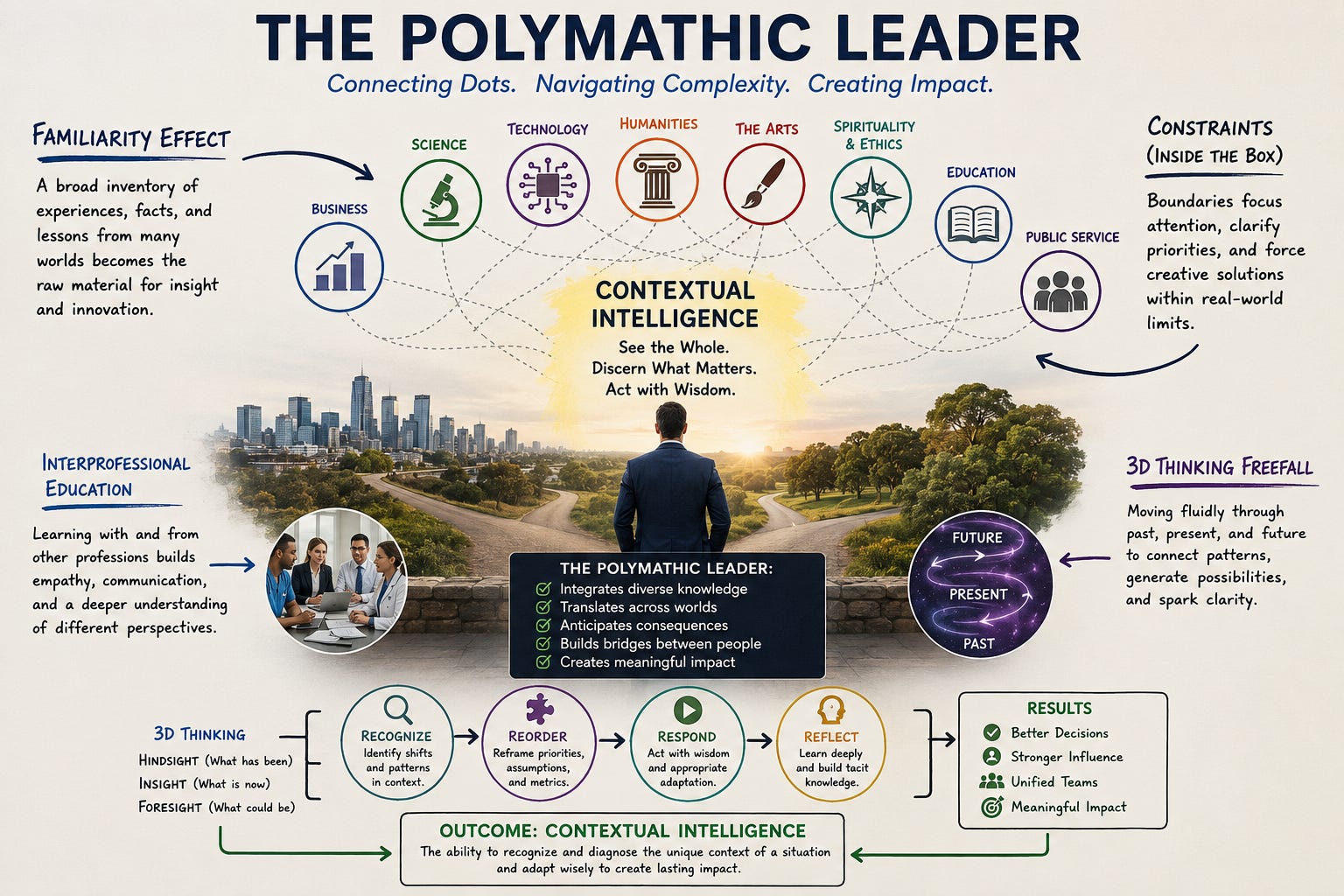
David Epstein’s work provides important support for this idea. In Range, Epstein argues that generalists are often well prepared for complex and unpredictable environments because they have encountered different problems, systems, and ways of thinking. Their advantage is not that they know more about every subject than a specialist. Their advantage is that they can recognize relationships between subjects that other people may treat as unrelated. Diverse experiences provide more analogies, patterns, and possible explanations from which to reason. This capacity is closely related to what I have dubbed 3D Thinking Freefall—the mind’s rapid movement among memories of the past, present circumstances, and expectations of the future, during which seemingly unrelated experiences can connect and produce a moment of clarity. For the polymathic leader, a broader portfolio of experiences makes this freefall more generative because the mind has more experiences, facts, and patterns available to connect.
This helps explain what might be called the familiarity effect. A leader who has worked in several industries, studied different disciplines, traveled across cultures, participated in ministry, engaged in the arts, or learned beside other professions possesses a larger inventory of facts and experiences. That inventory becomes intellectual raw material. When a new situation emerges, the leader has more places to look for a useful comparison. A lesson from athletics may clarify team performance. A principle from theology may reveal an ethical conflict. An idea from biology may explain organizational adaptation. A practice from education may improve communication. The facts matter, but their greatest value appears when the leader can connect them.
Epstein’s newest book, Inside the Box: How Constraints Make Us Better, adds a necessary qualification. Breadth alone does not produce better leadership. Unlimited information, choices, and opportunities can become distracting or even paralyzing. Epstein argues that appropriate constraints narrow attention, clarify priorities, and force people to explore beyond their usual solutions. The book’s discussion of creativity, boundaries, and “the remix of everything” suggests that innovation often occurs when familiar elements must be rearranged within a defined problem.
The polymathic leader has many experiences available but does not attempt to use all of them at once. The leader works within the constraints of the mission, the available resources, the needs of the people, the ethical standards of the organization, and the demands of the immediate situation. Breadth increases the number of possible connections. Constraints help determine which connections are useful.
Polymathy should therefore not be confused with intellectual wandering or shallow familiarity with many subjects. Polymathy should be seen through the combination of breadth, depth, and integration. The polymathic leader does not merely collect unrelated interests. The polymath develops sufficient knowledge in multiple areas and then combines that knowledge to create, interpret, or solve something. A polymathic orientation has been associated with creativity across several stages of innovation, while studies of Nobel laureates suggest that many highly creative people consciously use vocational and avocational interests to transfer ideas across disciplinary boundaries. These findings do not prove that every broadly experienced person will become an effective leader, but they support the value of disciplined cognitive diversity.
Interprofessional education provides a practical pathway for developing this kind of leadership. When people learn with, from, and about other professions, they encounter different vocabularies, standards of evidence, priorities, problem-solving methods, and assumptions. They begin to understand why a physician, educator, attorney, accountant, pastor, therapist, engineer, and community leader may interpret the same situation differently. Research on interprofessional education has found generally positive effects on attitudes, communication, collaborative knowledge, and teamwork skills, although the evidence connecting such education directly to long-term organizational or client outcomes remains less developed.
The polymathic leader is consequently more than a multidisciplinary learner. This leader becomes an intellectual translator. The leader can enter a conversation among specialists, understand the values and assumptions behind their recommendations, identify where their perspectives overlap, and recognize where professional blind spots may exist. This ability can increase influence because people are more likely to trust leaders who understand their work without pretending to replace their expertise. It can improve decision-making because the leader is less dependent on one explanation. It can also produce more meaningful impact because the leader sees how a decision made in one part of a system may create consequences somewhere else.
Yet the final outcome of polymathic development should not be described simply as knowledge, versatility, or creativity. Its most mature outcome is contextual intelligence. Contextual intelligence is the capacity to recognize and diagnose the variables shaping a situation and then adjust one’s behavior to fit those conditions. It includes the disciplined integration of hindsight, insight, and foresight: learning from what has happened, interpreting what is happening, and anticipating what may happen next.
Polymathy gives the leader a diverse portfolio of experiences. The broad range of familiarity effects gives the leader a broad supply of patterns and analogies. Appropriate constraints give the leader focus. Interprofessional education exposes the leader to competing but valuable ways of knowing. Contextual intelligence brings these elements together by helping the leader determine what matters here, what knowledge transfers, what must be adapted, and what should be left behind.
Contextual intelligence is therefore not an automatic benefit of polymathy. A person can be highly educated, widely traveled, and professionally diverse while remaining unable to read a room, diagnose a culture, or adjust to changing conditions. Breadth becomes valuable only when it is reflected upon, integrated, and applied with judgment. The polymathic leader emerges through diverse experience, but the contextually intelligent leader emerges when that experience becomes usable wisdom. In that sense, contextual intelligence is not simply one characteristic of the polymathic leader, but, it is the intended outcome of polymathic leadership.