

Becoming Less Wrong: What Superforecasting Taught Me About Better Decision-Making
Why the best decision-makers are not always the most certain—but the most willing to learn

I read a lot of books on thinking and decision-making. Some of my favorites are: Thinking in Bets, by Anne Duke; Thinking Fast, Thinking Slow, by Daniel Kahneman; Think Again, by Adam Grant. All great ones. I recently came across Superforecasting: The Art and Science of Prediction by Philip E. Tetlock and Dan Gardner, and I am embarrassed I didn’t find it sooner. I found myself reading it less as a book about prediction and more as a book about disciplined judgment. On the surface, it is about forecasting future events. But underneath, it is really about how thoughtful people can make better decisions in uncertain conditions.
That matters because most of us are forecasting all the time, even if we do not call it that. Leaders forecast whether an initiative will work. Parents forecast how a child may respond to discipline or encouragement. Educators forecast whether a student is ready for more responsibility. Clinicians forecast how a patient may respond to treatment, rehabilitation, or a return-to-play decision. Entrepreneurs forecast whether the market will care about what they are building. In other words, prediction is not a niche skill. It is embedded in everyday leadership, judgment, and life.
What Tetlock and Gardner helped me see is that good forecasting is not primarily about being brilliant. It is not about having a crystal ball, a louder opinion, or a more impressive title. The best forecasters are not necessarily the people who sound the most certain. They are the people who are humble enough to question themselves, disciplined enough to gather evidence, and courageous enough to update their beliefs when new information arrives.
That idea alone is worth sitting with. In many professional environments, confidence gets mistaken for competence. The person who speaks first, speaks loudly, or speaks with certainty is often treated as the person who knows. But Superforecasting reminds us that certainty and accuracy are not the same thing. In fact, premature certainty can be one of the greatest enemies of wisdom.
Better Decisions Begin When We Trade Certainty for Probability
One of the most important lessons I took from the book is that decision-making improves when we move from vague impressions to clear probabilities. Most of us use fuzzy language when we make predictions. We say something is “likely,” “unlikely,” “probably going to happen,” or “a long shot.” But those words can mean very different things to different people. My “probably” may mean 60 percent. Your “probably” may mean 85 percent. That gap matters when decisions, resources, reputations, or people’s lives are involved.
Tetlock and Gardner push the reader to think in probabilities. Instead of saying, “I think this will work,” a better sentence might be, “I am about 70 percent confident this will work, assuming these conditions remain true.” That kind of statement forces clarity. It makes our assumptions visible. It allows others to challenge our thinking more precisely. It also gives us a way to learn later, because we can return to the prediction and ask whether our confidence level was justified.
This has real implications for leadership. Leaders often feel pressure to sound certain, especially in moments of disruption or complexity. But the better move may be to say, “Here is what I believe is most likely, here is how confident I am, and here is what would change my mind.” That does not weaken leadership. It strengthens it. It shows that the leader is not hiding behind bravado but is practicing disciplined discernment.
Good Judgment Depends on Better Questions
Another major takeaway from Superforecasting is the value of breaking big questions into smaller ones. Big questions are often emotionally loaded and intellectually cloudy. Will this organization succeed? Will this program grow? Will this student thrive? Will this treatment plan work? And something that I am asking right now, Will this book reach the people it was written to help? These are important questions, but they are too large to answer well all at once.
The better approach is to break the big question apart. What would success actually look like? What has happened in similar situations? What evidence do we already have? What assumptions are we making? What would need to happen first? What could derail the outcome? What would we expect to see if we were on the right track? Smaller questions do not make the future certain, but they make our thinking more concrete.
This practice connects deeply with how I think about leadership and contextual intelligence. We rarely suffer because we lack information entirely. More often, we suffer because we have not framed the situation well enough. We are answering the wrong question, or we are answering a right question too vaguely. Superforecasting disciplines us to slow down, clarify the question, and separate what we know from what we assume.
The book also emphasizes what Tetlock calls the “outside view.” This means that before we become too absorbed in the details of our unique situation, we should ask what usually happens in similar situations. That is a humbling practice. Most of us like to believe our project, our organization, our family, our opportunity, or our challenge is different. Sometimes it is. But often, the base rate tells us something we need to hear before our hopes and fears take over.
For example, if I am evaluating whether a new initiative will succeed, I should not begin only with my passion for the idea. I should ask how similar initiatives have performed. I should look at common obstacles, typical timelines, failure rates, resource demands, and the patterns that repeat across comparable cases. The outside view does not replace vision. It disciplines vision. It keeps enthusiasm from becoming delusion.
That point feels especially important in a culture that loves exceptionalism. We tell ourselves that we are different, our team is different, our idea is different, and our circumstances are different. But wisdom often begins by asking, “What usually happens?” Once we understand the usual pattern, we can then ask whether we have legitimate reasons to believe our case may differ. That is a more mature form of optimism.
Wise Leaders Update Their Thinking Without Losing Their Spine
One of the most personally challenging lessons in Superforecasting is the need to update beliefs without ego. Good forecasters change their minds when the evidence changes. They do not treat every revision as a personal defeat. They do not cling to an outdated conclusion simply because they once said it out loud. They understand that learning requires movement.
This is difficult because many of us attach our identity to our judgments. Once we have made a public statement, launched a plan, defended a position, or invested emotionally in an outcome, it becomes harder to revise. But mature decision-making requires the ability to say, “I now see this differently.” That sentence is not weakness. It is wisdom doing its work.
In leadership, this may be one of the most important habits we can cultivate. A leader who never changes his mind is not necessarily strong. He may simply be insulated, defensive, stubborn, or unwilling to learn. A leader who changes his mind constantly without discipline is not wise either. The goal is not stubbornness or instability. The goal is calibrated updating—changing our level of confidence as better evidence becomes available.
Tetlock and Gardner also make a helpful distinction between “hedgehogs” and “foxes.” Hedgehogs tend to organize their thinking around one big idea. Foxes draw from many ideas, many sources, and many perspectives. Superforecasters tend to be more fox-like. They are curious, integrative, iterative, and less likely to force every situation into a favorite theory.
That distinction resonated with me because complexity rarely yields to one-dimensional thinking. In leadership, healthcare, education, ministry, marriage, parenting, and organizational life, one model is almost never enough. We need multiple lenses. We need hindsight, insight, and foresight. We need data and discernment. We need principles and context. We need enough humility to admit that our favorite explanation may not be sufficient.
This is also why teams matter. Superforecasting shows that forecasting can improve when people think together well. But that last phrase is the key: together well. A group does not automatically make better decisions simply because more people are involved. Teams can become echo chambers. They can reward conformity. They can punish dissent. They can mistake consensus for accuracy.
A healthier team creates room for disagreement before the decision is made. It asks, “What are we missing?” It invites someone to make the strongest case against the preferred plan. It separates loyalty from agreement. It recognizes that a person can be deeply committed to the mission and still challenge the current strategy. In fact, that kind of challenge may be one of the greatest expressions of commitment.
Becoming Less Wrong Requires Practice, Feedback, and Humility
For me, one of the most practical outcomes of reading Superforecasting is the idea of keeping a prediction journal. This does not need to be complicated. It could be as simple as writing down a few forecasts each week with a percentage attached to each one. Then, after enough time has passed, I can return to those forecasts and ask what happened. Was I too confident? Too cautious? Did I ignore important evidence? Did I update too slowly?
That kind of practice is uncomfortable because it creates accountability. Most of us prefer to remember our hits and quietly forget our misses. But growth requires feedback. If I never revisit my predictions, I can keep telling myself I have good judgment without ever testing whether that is true. Superforecasting invites a better way: measure, learn, adjust, and improve.
The book also reminded me that outcomes and decisions are not the same thing. A bad decision can sometimes produce a good outcome because of luck. A good decision can sometimes produce a bad outcome because the world is uncertain (which is something Anne Duke explains in her book too). This is a critical distinction. If we judge every decision only by the outcome, we may reward recklessness when it gets lucky and punish wisdom when it encounters forces beyond its control.
That insight is especially important for leaders. We need to evaluate the quality of the thinking process, not merely the final result. Did we ask the right questions? Did we examine the evidence? Did we seek alternative views? Did we consider base rates? Did we identify assumptions and biases? Did we update as new information appeared? Those questions help us become better decision-makers even when the outcome was not what we hoped.
The great promise of Superforecasting is not that we can become perfectly accurate. We cannot. The world is too complex, too dynamic, and too full of variables beyond our control. The promise is more modest and more useful: we can become less wrong over time. We can reduce preventable error. We can catch overconfidence earlier. We can make our assumptions visible. We can become more disciplined in how we think about the future.
Superforecasting does not give us a formula for certainty. It gives us habits for wisdom. And in a world addicted to confidence, speed, and noise, habits of wisdom may be one of the most valuable things we can cultivate.
So here is my practical challenge after reading Tetlock and Gardner: make your next decision more forecastable. Write down what you think will happen. Assign a probability. Name your assumptions. Ask what would change your mind. Seek one disconfirming perspective. Then return later and review what you got right, what you missed, and what you learned.
That may not sound dramatic, but it can be transformative. Better judgment is rarely built through one grand insight. It is built through small disciplines repeated over time. Superforecasting reminded me that the goal is not to be the loudest voice in the room or the most certain person at the table. The goal is to become wiser, clearer, humbler, and, little by little, less wrong.
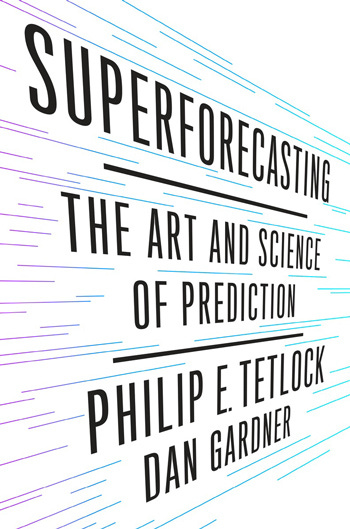
Source cited:
Tetlock, P. E., & Gardner, D. (2015). Superforecasting: The Art and Science of Prediction. Crown Publishers.